 New!
New!
 Outdoors
 Apparel & Accessories
 Footwear
 Firearms & Archery
 Safety
 Our Swag
 Body
Body
 Travel
 Trail Notes
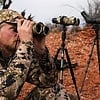
Whether you’re scanning dense timber for whitetail in the valleys or glassing distant alpine ridges for mountain goat, your optics are your primary tool for locating game and making ethical decisions.
Choosing the right optic isn't about buying the most expensive gear on the shelf—it's about matching magnification, objective lens size, and glass quality to your specific terrain and target species.
Here is your straightforward guide to selecting the ideal glass for your next hunting trip, brought to you by Monashee Outdoors.
Binoculars: Your All-Day Workhorse
Every hunter needs a reliable pair of binoculars. They save your feet by allowing you to scout vast swathes of terrain from a single vantage point.
Understanding the Numbers
When looking at binoculars, you’ll see two numbers separated by an "x" (e.g., 8x42 or 10x42):
- First Number (Magnification): How many times closer the object appears.
- Second Number (Objective Lens Diameter): Measured in millimeters, this dictates how much light enters the optic. Larger lenses provide brighter images in low-light conditions but add weight.
Matching Binoculars to Your Terrain
| Hunting Environment | Recommended Specs | Key Advantages |
| Heavy Timber & Brush | 8x32 or 8x42 | Wider field of view, easier to steady freehand, lighter to carry through thick brush. |
| All-Around / Mixed Terrain | 10x42 | The gold standard. Excellent balance of power, light transmission, and field of view. |
| Open Country & Alpine Ridges | 12x50 or 15x56 | High magnification for long-range scanning. Best used mounted on a tripod for stability. |
Find the perfect pair of glass for your hunt: Explore Binoculars
Rifle Scopes: Precision at the Point of Impact
Your rifle scope is the bridge between spotting your target and making a precise, clean shot. Selecting the right scope depends on your firearm type, expected shooting distances, and typical light levels.
Key Factors to Consider
Magnification Range:
- 3-9x or 2.5-10x: Ideal for dense forests and moderate-range shots (under 250 yards). Offers rapid target acquisition.
- 4-12x or 4-16x: Great for open country, clear-cuts, and prairie hunting where shots may stretch farther.
Lens Coatings & Glass Quality: Fully multi-coated lenses maximize light transmission during peak game activity—dawn and dusk.
Mounting Integrity: A premium scope is only as good as its rings and mounts. Ensure you match your scope tube diameter (1 inch, 30mm, or 34mm) with heavy-duty mounting hardware.
Explore Optics: Browse our selection of Scopes and Rings & Bases
Spotting Scopes: Long-Range Detail & Horn Evaluation
When you need to count points, judge horn length, or evaluate an animal's mature status miles away before making an difficult stalk, a spotting scope is indispensable.
Straight vs. Angled Eyepieces
- Straight Eyepieces: Faster for acquisition when looking down at lower terrain or tracking moving game. Easier to use from a vehicle window mount.
- Angled Eyepieces: Far more comfortable for prolonged glassing sessions, especially when pointing uphill into high alpine basins or sharing a tripod with hunting partners of different heights.
Objective Lens Sizes
- 50mm–65mm: Compact, lightweight, and ideal for backcountry backpack hunts where every ounce counts.
- 80mm–85mm+: Heavier, but provides maximum resolution and light gathering in early morning or late evening glassing sessions.
Browse our collection of Spotting Scopes
Quick Checklist for Buying Optics
- Match the Terrain: Don't drag a heavy 15x binocular into thick woods; don't count on a 4x scope for long-range mountain glassing.
- Prioritize Light Transmission: Low light is when big game moves most—look for fully multi-coated, low-dispersion (ED/HD) glass.
- Protect Your Investment: Always pair your glass with clean lens caps and protective optics harness systems.
- Check Used Options: Looking for high-end glass on a budget? Check out pre-owned optics for excellent value.
Get Geared Up: Browse the full lineup in our Optics Department.
Disclaimer: This article was written with the assistance of Generative AI